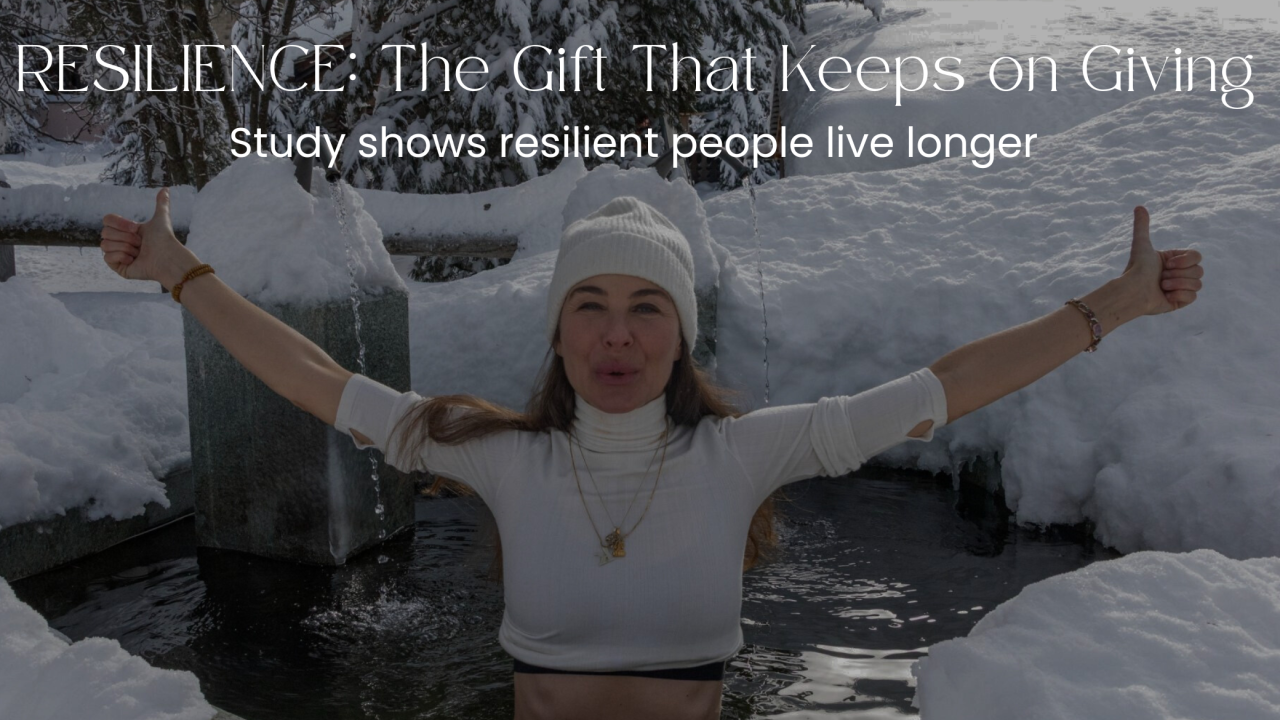
Study shows resilient people live longer
As we approach the festive break, many of us will naturally reflect on what the year has asked of us. The triumphs and the trials. The lessons we did not expect and the strength we did not know we had. Whether we recognise it or not, these moments have been building something powerful inside us. Resilience.
Resilience is the ability to adapt, recover and grow. It is not an innate trait reserved for the lucky. It is a living, evolving capacity that emerges from within. It is something you can nurture to enhance your health and performance every day. Now the science confirms it’s a pillar of longevity.
Study Shows Resilience Extends Life
The capacity to withstand life’s stressors appears to influence how long we live.
In a major national cohort study, the Health and Retirement Study in the United States, researchers followed 10,569 adults aged fifty and older. Published in BMJ Mental Health, the findings were striking. Higher psychological resilience was strongly associated with a lower risk of death from all causes.
For every standard deviation increase in resilience, the risk of dying over the follow-up period fell by about 25%, even before adjustments for health or lifestyle factors.
Further analyses revealed an even more compelling pattern. Adults in the highest resilience quartile were 38% less likely to die over the next decade than those in the lowest quartile. The relationship was almost linear. The higher the resilience score, the lower the mortality risk. This effect was even stronger in women.
The Leading Voices in Resilience Science
I began to understand the quiet power of resilience in my thirties when my father died. I found healing in the mountains and snow and learned to ski and ski tour. At the time, resilience was not widely discussed. Today, the field has matured, and I deeply admire the thinkers who have brought clarity to it.
One of them is Dr. Taryn Marie Stejskal, a global authority on resilience and the bestselling author of The Five Practices of Highly Resilient People. Her work shows that resilience is a learned set of practices grounded in values, rest, emotional regulation, connection and adaptive response. It is a discipline rather than a personality trait.
Another leading figure is Dr Ann Masten, whose research introduced the idea of resilience as “ordinary magic”. She demonstrated that resilience is not an extraordinary feature but an everyday human capacity built on our normal adaptive systems. Her work points to something vital. Longevity foundations are built from the habits and coping strategies we develop from childhood onward.
Professor George Bonanno, the clinical psychologist at Columbia University, has shown that most people naturally regain stability after loss or trauma. His recent work highlights that resilience arises from flexible, context-sensitive emotional regulation, not from rare internal strength.
Dr Lucy Hone, co-director of the New Zealand Institute of Wellbeing and Resilience, blends academic research with deeply personal experience following the death of her daughter. Her approach, known as “resilient grieving”, centres on three principles.
- Accept adversity as part of life.
- Focus on what can be controlled.
- Choose helpful thoughts and actions.
Her TED Talk, “3 Secrets of Resilient People,” is among the top 100 talks, and she has become a global advocate for grief literacy and long-term well-being.
Resilience Is a Gift
My resilience has grown – and continues to grow – in the mountains, leading a business and being an innovator in aesthetic medicine and now longevity with Epigenedits hyperbaric oxygen chamber.
I believe resilience is a gift. It’s a daily practice that begins with awareness and recognising where you stand and what you need next. And based on the latest findings, it may also give you more years with the people you love and more joy across every season.
“Resilience is the moment you choose to continue. It is the anchor of a long, vibrant and joyful life.” Dr Katrin Dreissigacker