In 2025, one thing became unmistakably clear: oxygen, delivered with pressure, precision and consistency, can influence how we age at a cellular level.
I had already experienced how hyperbaric oxygen therapy (HBOT) supported my performance, recovery and mental clarity. What 2025 added was confirmation. HBOT is transitioning from a niche biohacking tool into a recognised longevity intervention.
The convergence of advancing research, growing mainstream awareness and improved accessibility through home-based systems has created ideal conditions for market expansion. The global HBOT market is projected to grow from approximately USD 4 billion in 2025 to over USD 6.5 billion by the early 2030s, reflecting a broader shift toward preventive and performance-focused longevity strategies.
What changed in 2025: real-world human data
What truly moved the HBOT conversation forward in 2025 was not a single laboratory breakthrough, but high-quality, real-world human data.
One of the most closely observed examples came from Bryan Johnson, whose longevity programme is among the most comprehensively measured and transparently documented worldwide. In 2025, HBOT became a consistent component of his protocol.
Across a structured, multi-week programme, Johnson reported measurable improvements across several physiological domains, including reductions in inflammatory markers, improved vascular indicators and enhanced cognitive performance metrics. Crucially, these outcomes were tracked longitudinally, using frequent biomarker testing and third-party validation.
What made this data meaningful was not the individual, but the methodology. Continuous measurement, consistency of exposure and cautious interpretation shifted HBOT away from theoretical promise and toward observable human adaptation.
At the same time, peer-reviewed literature and clinical discourse in 2025 increasingly focused on mechanism rather than marketing: oxygen utilisation, mitochondrial efficiency, neuroplasticity and recovery capacity.
The narrative matured. HBOT was no longer positioned as a miracle intervention, but as a biological lever, effective when used correctly, regularly and as part of a broader longevity framework.
How oxygen supports healthy ageing
Under hyperbaric conditions, oxygen dissolves directly into plasma, allowing it to reach tissues that are otherwise under-supplied. This creates a controlled biological stress – hormesis – which activates repair and adaptation mechanisms, including:
- improved mitochondrial efficiency
- reduced systemic inflammation
- angiogenesis and neuroplasticity
- enhanced cognitive performance and recovery
One insight matters more than any headline: consistency. Meaningful cellular adaptation does not come from occasional intensity. It comes from repetition over time.
This is where 2026 enters the story.
Medical vs wellness HBOT: An essential distinction
As HBOT moves into the mainstream, clarity matters.
Medical HBOT is designed for acute pathology. It is delivered in hard-shell chambers at high pressure, under clinical supervision, for defined medical indications. It is powerful and intentionally episodic.
Wellness-focused HBOT operates differently. Using soft-shell chambers at lower pressures, it supports oxygen availability, mitochondrial function and recovery without overwhelming the system. This gentler approach allows for regular use and regularity is where longevity benefits emerge.
Soft-shell chambers are not a compromise. They are a design choice, prioritising safety, accessibility and long-term integration into daily life.
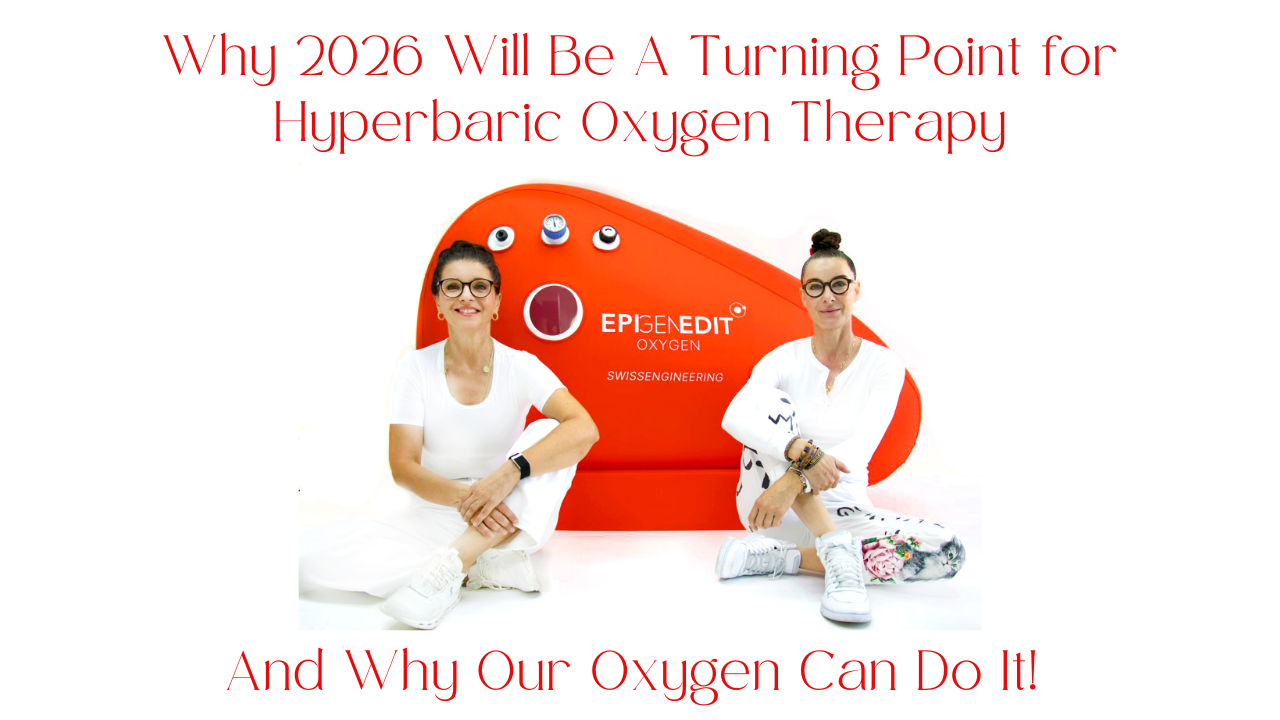
At EpigenEdit, this distinction shaped every decision we made. Our soft-shell hyperbaric chamber is not a medical device. It is a wellness technology designed to support health and vitality from the inside out and to be used consistently at home.
This is why 2026 will be an inflection point. HBOT is moving from niche intervention to a foundational daily longevity practice, alongside strength, nutrition, sleep and stress regulation.
Final thought
“Longevity is not about forcing change, but about giving the body the oxygen it needs to regenerate, rejuvenate and radiate, naturally and consistently.”
— Katrin Dreissigacker | Co-Innovator EPIGENEDIT Soft-Shell Hyperbaric Oxygen Chamber