I use the word optimisation almost every day. In consultations, at congresses, in conversations about longevity science. It is a good word, precise and purposeful. But lately I have started to wonder whether we have taken it somewhere it was never meant to go.
76% of employees experience burnout at least occasionally, and burnout now costs the global economy $322 billion annually in lost productivity and turnover. This is not a wellness statistic. It is a verdict on a culture that has confused doing more with being better.
We are the most optimised generation in history. We are also, by most measures, one of the most depleted.
What optimisation was always supposed to mean
I was recently at AMWC in Monaco, three days of conversation with some of the world’s leading practitioners that confirmed what the best science in our field is quietly but firmly concluding.
True optimisation does not begin on the surface. It begins in the cell.
Monaco was about the better self, the more vital self, the healthy self, the regenerated self. And yes, the outwardly optimised self too. But arriving at that self through biology, not around it. What was explored was a much deeper understanding of how we can support the body and skin from within.
The biology underneath
Here is what most optimisation culture overlooks. When the body ages at a cellular level, everything follows. Energy, recovery, cognitive sharpness, skin quality, resilience under pressure. These are not separate problems. They share a single origin: the cell.
At the centre of cellular ageing sits the mitochondria, the structures responsible for producing the energy every cell needs to repair and function. When mitochondrial health declines, the whole system feels it, often long before it becomes visible. The surface is not the problem. It is the signal.
The science of going deeper
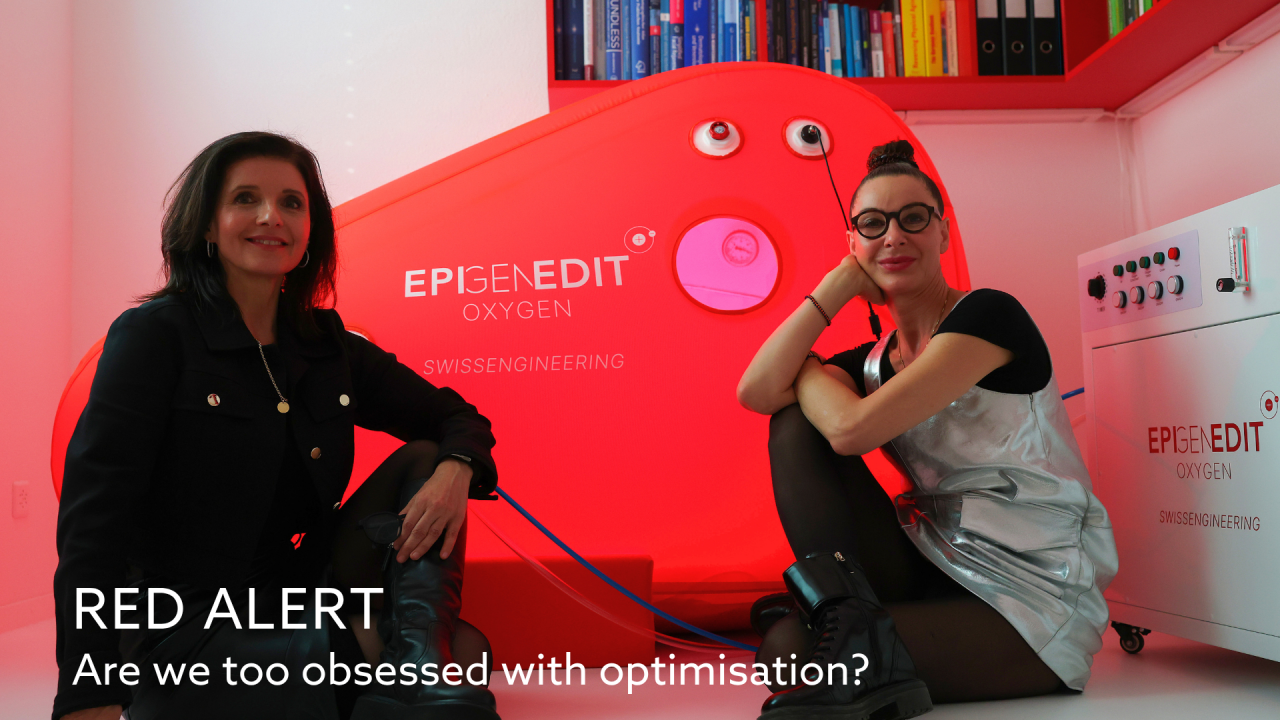
Red light therapy stimulates mitochondrial function, increasing cellular energy production, reducing inflammation, and improving circulation. When combined with hyperbaric oxygen therapy, the effect is amplified. HBOT increases oxygen delivery deep within tissues. Red light improves how efficiently cells use it. Together, they support faster recovery, improved performance, and long-term vitality.
The evidence is compelling:
- 36% wrinkle reduction and 19% improvement in skin elasticity in a randomised, placebo-controlled trial. Not cosmetic outcomes. Evidence of cellular repair.
- 800% increase in circulating stem cells following a structured HBOT protocol, alongside measurable reductions in systemic inflammation.
- Consistently enhanced tissue repair markers and reduced oxidative stress with regular photobiomodulation, across research spanning 2021 to 2025.
Consistency, not intensity, is the key to sustained optimisation at a cellular level and in life.
A different definition of optimised
The temptation is always to add another layer to the stack. But the question worth sitting with is not what else can I add. It is whether I am addressing the biology underneath.
That is what Monaco reminded me, and that is what thirty years in medicine keeps teaching me. Optimisation was always meant to mean giving the body what it genuinely needs to repair, regenerate, and perform. Not forcing it. Not decorating it.
The most optimised version of you is the one whose cells are actually working.
Final Thought
“Longevity is not created by a single intervention. It emerges when mindset, biology and daily choices align.” — Dr. Katrin Dreissigacker
References
- Workhuman / Gallup (2024). State of Employee Wellbeing Report.
- Miwa, S. et al. (2022). Mitochondrial dysfunction in cell senescence and aging. Journal of Clinical Investigation.
- Lee, S.Y. et al. (2007). LED phototherapy for skin rejuvenation. Journal of Photochemistry and Photobiology.
- Physical Achievement Center (2025). Red light therapy: mitochondrial chromophores and cellular response.
- Thom, S. et al. (2006). Stem cell mobilization by hyperbaric oxygen. American Journal of Physiology, Heart and Circulatory Physiology, University of Pennsylvania.