Healthier longevity comes from consistency, not extremes
Elite athletes are no longer defined by short careers followed by inevitable decline.
Increasingly, they are becoming living examples of how health, vitality and performance can be sustained over time. Their relevance now extends far beyond sport. They offer a practical blueprint for ageing well.
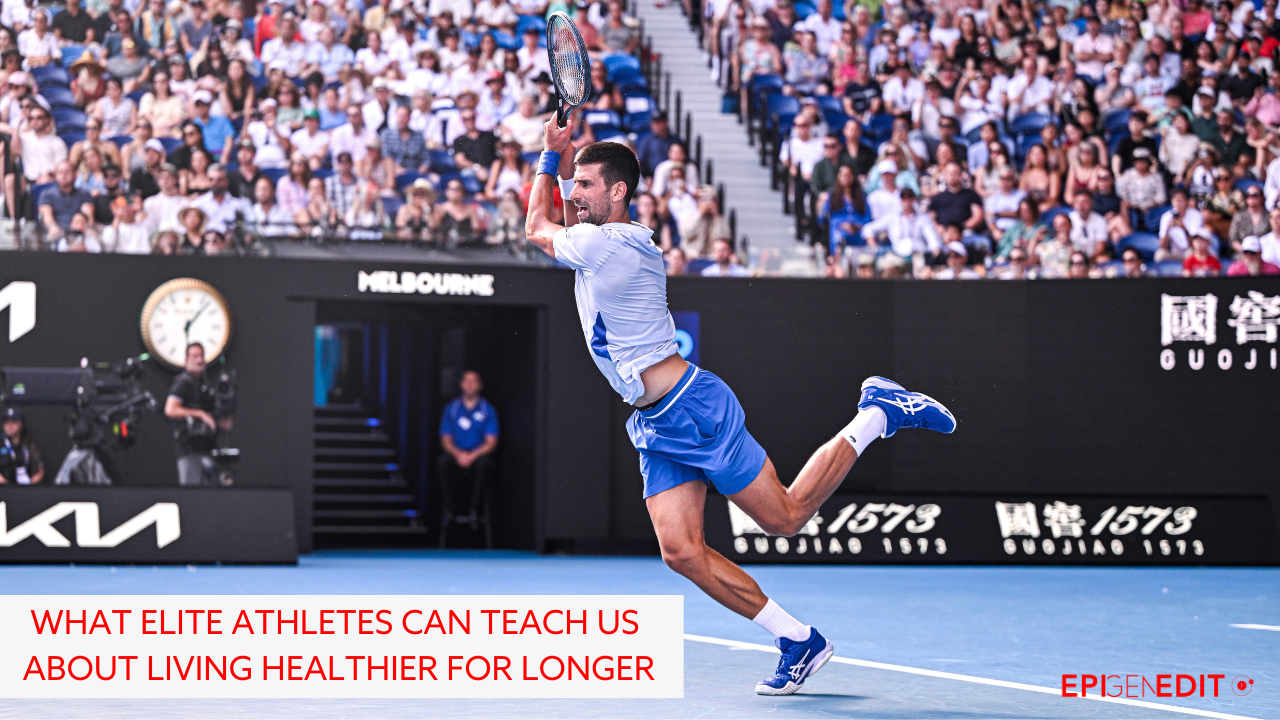
Consider Novak Djokovic, still pursuing his twenty-fifth Grand Slam title in his late thirties. His longevity is not the result of pushing harder or training longer. It reflects something more precise: the disciplined repetition of behaviours that protect health while sustaining performance. Nutrition, recovery, hyperbaric oxygen therapy, stress regulation and mindset are treated as foundations, not optional additions.
This is the central lesson elite sport offers longevity science and ordinary people today.
We do not simply want to live longer. We want to live healthier for longer, with strength, clarity and resilience intact.
Longevity is built on consistency, not extremes
Elite athletes understand something intuitively that modern longevity research now confirms. Long-term vitality is not built through extremes, but through systems that can be sustained.
They optimise recovery as carefully as training. They respect biological limits rather than overriding them. Most importantly, they focus on routines they can repeat every day, year after year.
What they demonstrate is not superhuman ability, but biological stewardship, which is precisely what ageing well requires.
This perspective is strongly supported by Luigi Fontana, Director of the Healthy Longevity Research Program at the University of Sydney and Washington University.
His research consistently shows that longevity does not emerge from heroic interventions, but from long-term balance between energy intake, movement, stress regulation and recovery. Consistent biology, not short-term intensity, determines outcomes.
Mindset is a physiological asset
Athletes who endure into later decades share a distinct capacity for psychological regulation. Djokovic and other long-performing athletes speak openly about emotional control, focus and mental flexibility.
Longevity research mirrors this observation. Positive psychological states are associated with lower chronic inflammation, improved immune function and greater adherence to healthy routines. In this context, mindset is not motivation. It is a biological stabiliser that shapes how the body adapts over time.
Recovery and oxygen as foundations of vitality
Modern performance science is clear. Recovery creates capacity. Strategies that support oxygen delivery, mitochondrial efficiency and inflammation resolution are essential for sustained performance and long-term health.
One modality increasingly explored in elite sport and longevity medicine is hyperbaric oxygen therapy. Research led by Shai Efrati, Director of the Sagol Center for Hyperbaric Medicine and Research, shows that ageing is not only a function of time, but of how well oxygen-dependent repair mechanisms are maintained.
This insight was one of the reasons we created the EpigenEdit soft-shell hyperbaric oxygen chamber. Not to chase extremes, but to make an evidence-based recovery tool accessible beyond elite environments and into everyday life.
Vitality should not be reserved for those with full medical teams. It should be designed into daily living.
A personal reflection
I began playing tennis at fifty-six, not to compete, but to learn. To build coordination, resilience and joy through movement. Sport teaches us, at any age, how adaptable the human body remains when we give it the right signals.
Elite athletes simply remind us of something deeply human. Performance is not a phase. It is a practice.
Final thought
“Vitality is not about pushing harder. It is about supporting the biology that allows us to keep moving, learning and performing at every stage of life.”
Katrin Dreissigacker