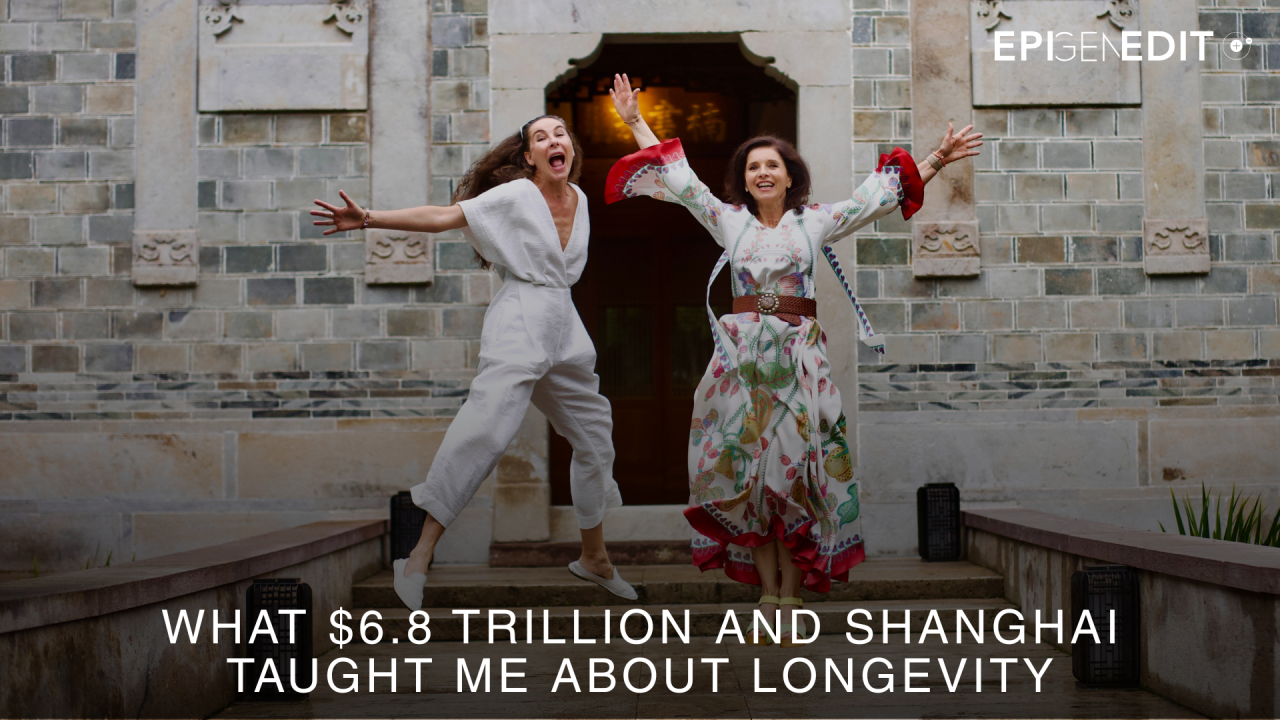
The world is spending $6.8 trillion a year on wellness. Walking through Shanghai, I found myself wondering how much of that we actually need. Are we investing in our health, or just investing in the idea of it and the latest trends?
Life expectancy tells an interesting story here. Monaco leads the global rankings at 86.5 years, followed by Japan and Switzerland, both at 84.4. China, at 79 years, doesn’t top those tables. But here’s what the statistics don’t capture: China has achieved a life expectancy that surpasses 21 higher-income nations, ranking 10th among G20 countries, not through pharmaceutical spend, but through something far older and harder to package.
Walking through Shanghai, I kept thinking: people here seem remarkably alive.
What I saw in Shanghai
The statistics matter, but so does what you observe when you’re actually there:
- Food that still feels much closer to real food than ultra-processed convenience
- Parks where movement, morning and evening, looks more like a social gathering than a workout
- Home medicine cabinets where centuries of traditional wisdom sit comfortably alongside modern medicine
Long before personalised medicine became mainstream, Chinese medicine was already built around understanding the individual as a whole. What fascinated me most was how seamlessly China holds both. One moment I was in a traditional tea ceremony. The next, I was standing in front of some of the most advanced hyperbaric oxygen therapy chambers I’ve encountered anywhere in the world. Ancient apothecary cabinets alongside next-generation health technology, not in tension with each other, but building on one another.
The future doesn’t replace the past. It builds on it.
The booming wellness economy
The wellness economy is now nearly four times the size of the pharmaceutical industry, reaching $6.8 trillion in 2024 and projected to hit $9.8 trillion by 2029. People don’t want treatment anymore. They want to:
- Understand their own biology
- Participate in their health decisions
- Take genuine ownership of how they age
We are not at the beginning of a healthcare revolution. We are in the middle of it.
What Shanghai left me with
In the West, we talk a lot about leaky gut, chronic inflammation, bio-hacks and longevity stacks. In Shanghai, the mindset felt different. More like: make every day a little healthier, so you don’t have to optimise quite so aggressively later.
Looking at your own life, which mode are you in?
- “I optimise hard”
- “I’ve designed a daily routine that quietly takes care of me”
The wellness economy is extraordinary. The science is moving fast. But the most enduring thing I witnessed in Shanghai had no price tag. It was a culture that had built health into the rhythm of daily life so quietly, it barely had a name.
Maybe the most interesting longevity question isn’t how old we become. It’s how many of those years feel truly lived, rather than carefully managed.
“Spending more on wellness doesn’t make you healthier. Spending it wisely might. Shanghai reminded me there’s a difference.”
Dr Katrin Dreissigacker