
How the Longevity Economy Is Echoing the Early Days of the Aesthetic Medicine Industry
Data from UBS projects extraordinary growth in what they call the longevity economy — the total economic activity generated by increased human life expectancy. By 2050, the number of people aged over 60 will surpass 2 billion worldwide.
UBS describes a future where wellness becomes infrastructure: clinics, communities, real estate, services, technologies, and financial systems built around longer, healthier, more productive lives. The sector is expected to reach $8 trillion globally by 2030, up from $5.3 trillion in 2023, driven by medical innovation, ageing populations, and a cultural shift toward optimising healthspan.
And when I read the report, something felt deeply familiar.
Two Markets, One Pattern
When I opened my first aesthetic medicine clinic over 20 years ago, the global aesthetic treatments market was under $5 billion. Today, according to Grand View Research, the global aesthetics market exceeds $75 billion and continues to grow rapidly.
Even in those early days, it was clear to me that beauty was only the surface of truth. Although I helped pioneer the blunt cannula pix’L technique – a gentler, safer alternative to sharp needles that earned me the nickname “Queen of Needles” – I found myself guiding patients far beyond injectables. What they ultimately wanted was health, resilience, confidence and renewal.
It marked a turning point – especially for women – in how science and self-care intersected.
Because when people feel empowered to take control of their own biology, entire industries shift. Today, the longevity sector is following the exact same pattern as aesthetic medicine, only on a far greater scale.
The Opportunity Ahead
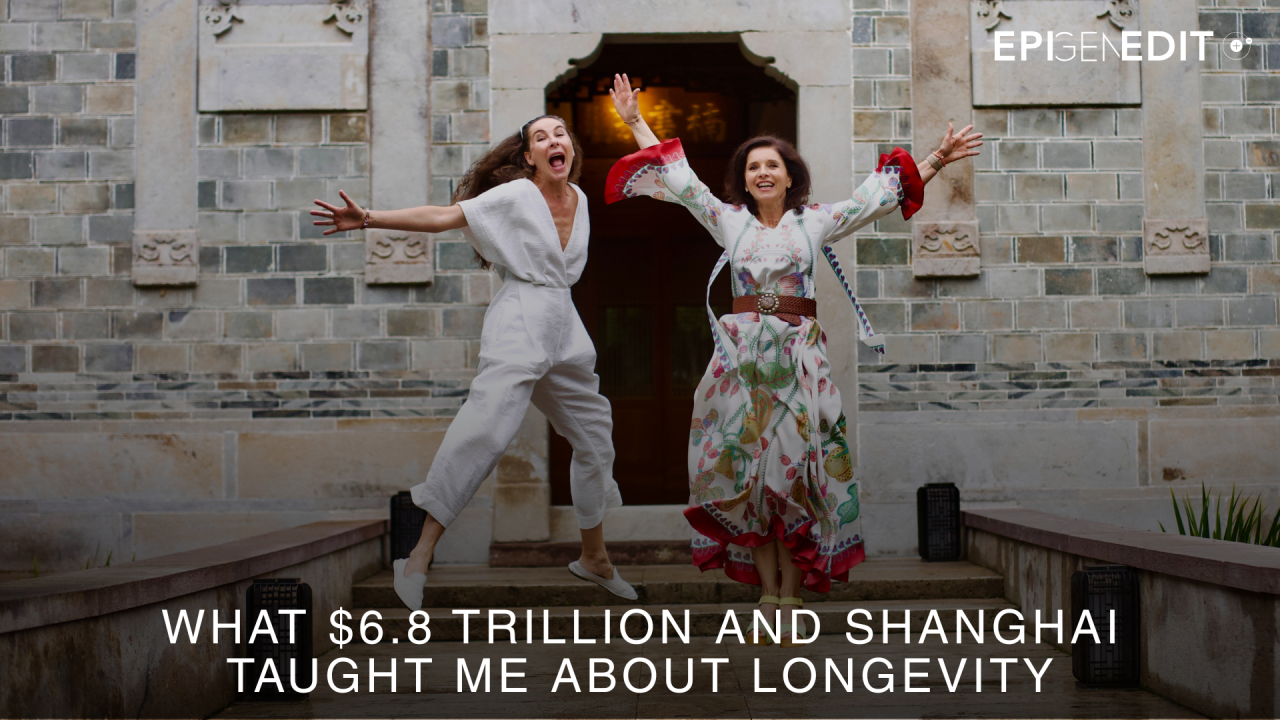
Five years ago, as Danijela Schenker and I entered our own midlife inflection point. We noticed women – particularly women 45+ – asking the same question we were asking ourselves:
“How do I maintain my clarity, energy and confidence and design how I age?”
Around us, breakthroughs in epigenetics, AI diagnostics, cellular repair, and oxygen-based therapies were accelerating faster than the traditional clinic model could absorb.
This convergence led us to create EpigenEdit and become longevity architects to translate complex science into real-life protocols that restore vitality.
In many ways, our work aligns exactly with the three forces UBS identifies as defining the next decade of longevity:
1. Preventive Health as Everyday Life
Longevity will not be a “treatment.” It will be a lifestyle – built into daily routines, workplaces, and homes.
2. Integrated Living Environments
Homes, clinics, hotels, gyms and communities will be designed around recovery, sleep, oxygenation, mental clarity and metabolic stability. This is why we Swiss-engineered EpigenEdit’s soft-shell hyperbaric chamber, to make oxygen-based wellness an everyday practice.
3. Backing Founders Reimagining Health
The most impactful companies will be those building systems that are accessible, sustainable, evidence-based and human-centred.
Women Leading the Longevity Economy
One of the most inspiring aspects of this sector is the calibre of women shaping it, not only as users, but as scientists, founders, thinkers and cultural architects.
Kayla Barnes-Lentz – driving global education on female longevity
Carol Greider – Nobel Prize laureate advancing telomere and genomic stability research
Arianna Huffington – reframing energy, sleep and stress science through Thrive Global’s behaviour-change model.
Melinda French Gates – advancing women’s health equity and funding innovations that expand access to life-extending technologies.
And organisations like Health2Wealth Association in Switzerland – a small, intentional, action-oriented community led by Anders Bally, PhD Nadine Esposito and Dr. Guénolé Addor, MD – brings together experts, entrepreneurs and clinicians to advance proactive health and long-term wellbeing.
Final Thoughts
We are entering a decade where ageing becomes the defining economic, medical, societal and cultural topic of our time.
UBS is right: the question is no longer whether longevity is investable.
The real question though is this: how do we build systems that make it sustainable, accessible and real?
For me, the answer is the same today as it was 20 years ago.
Build with science. Lead with empathy. Innovate where life demands a solution.
And never underestimate what reinvention can make possible